
When to Call an Equipment Damage Consultant is Just as Important as Why
By Paul Christoferson, Senior Building Consultant
When power is suddenly lost, many insureds instinctively call a generator rental company, believing this is the fastest way to restore operations. In practice, this is often the first step in a series of costly missteps.
Within the insurance consulting industry, certain risk scenarios appear repeatedly across sectors. Electrical power outages are among the most common and disruptive events, impacting businesses, communities, and insurers alike. Their frequency and wide-ranging consequences make them a critical focus for consultants seeking to:
- Mitigate avoidable claim costs for carriers
- Reduce business interruptions and extra expense exposure for insureds
- Restore operations as quickly and safely as possible
Electrical Power Outage Claims: A Real-World Equipment Damage Example
The following scenario, taken from an FM Boiler RE Lessons Learned article, illustrates how quickly extra expense can escalate without early expert involvement:
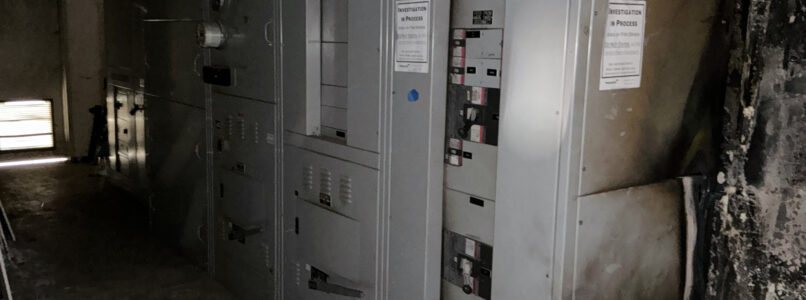
“A sudden power surge damaged an electrical switchgear, a key component in the electrical distribution system. Electrical arcing inside the unit caused severe discoloration and melted bus bar connections—clear signs of intense heat and neglect. Observations from a consulting firm’s inspection revealed that the damaged switchboard had not been properly maintained during its service life.”
The switchboard had to be replaced.
“To keep operations running, the insured rented a generator. However, finding an electrical contractor to make the repairs took months. The result: nearly 150 days of open claims activity, mounting rental fees, and a final extra expense nearly six times the cost of the actual repair.”
The extra expense associated with restoring power after an electrical emergency is often one of the most critical parts of a claim. In these high-pressure situations, the immediate priority is typically to get the “lights back on.” The response can become even more urgent when damage affects:
- Large commercial office complexes
- Industrial parks with multiple tenants
- Manufacturing facilities or plants that employ thousands of people.
In these scenarios, decisions are often made quickly and without a defined cost-control strategy.
A Common Claims Pitfall: Generator Rentals as a First Response
When power goes out unexpectedly, calling a generator rental company may seem like a logical first step Finding expert guidance is the best way to map out a path to restoring operations and avoid costly errors.
Based on over four decades of electrical property damage consulting and contracting experience, case studies consistently show that defaulting to generator rentals without expert guidance leads to unnecessary expense, prolonged downtime, and complex logistical challenges.

The Correct First Step after Electrical Equipment Damage
The most effective first action following electrical equipment damage is to engage the insurer immediately, allowing them to mobilize specialized consultants and engineers.
These experts can:
- Quickly assess whether the outage stems from utility infrastructure or customer-owned equipment
- Evaluate options to restore power safely and cost-effectively
- Develop an actionable plan before emergency measures are locked in
Prioritizing Work-Around Solutions
Whenever possible, the immediate plan should focus on identifying a work-around approach that restores power without relying on portable power generation systems and all the accessories that support that option. Examples may include:
- Installing cable systems around the damaged electrical component, continuing to use the main utility power source.
- Bypass the entire main power source dependent on amount of damage with short term equipment, continuing to use the main utility power source.
Diesel generators should be the last resort for building power systems, particularly for long-term scenarios, due to the exorbitant costs involved.
Coordinating Electrical Contractors, Utilities, and Authorities
Once the root issue(s) are identified and a viable conceptual plan is established, the consulting expert will:
- Engage an electrical contractor capable of completing emergency operations scope of work.
- Confirm the contractor has experience with complex temporary power solutions, as not all of them do this.
- Coordinate with the utility company and Authorities Having Jurisdiction (AHJ) for permits in getting the temporary work approved.
The ultimate goal is to:
- Safely reconnect the utility power source where possible
- Bypass the damaged electrical equipment while repairs are completed
- Many times, this is possible with existing onsite equipment that is operational or purchase some temporary off-the-shelf equipment that supports the work-around.
- Restore operations in the most expedient, practical, and safe manner.
Necessary Generator Use in Electrical Equipment Damage Claims
In some cases, the emergency may require the use of a generator… or two, three or more? When this occurs, informed planning is essential.
Key Considerations Before Renting Generators After Electrical Equipment Damage
- Conduct a quick load study to determine how much power you need
- Size generators to each service connection rather than defaulting to “one big one” simply because it’s available
- Evaluate whether the need is short- or long-term
For extended generator use, decisions become increasingly complex. An experienced consultant can:
- Help define operational needs and power demands
- Evaluate cost scenarios and comparison cost options for alternatives
- Develop a clear scope of work
- Solicit competitive bids
Managing Long-Term Generator Contracts in Power Outage Claims
The ultimate goal in any extended power loss scenarios is to mitigate long-term costs, many of which may not be recoverable under policy limits.
Key cost-control strategies include:
- Negotiate rental contracts with duration and value in mind
- Structure agreements as rent-to-purchase agreement when rental costs approach equipment value
- Explore alternative suppliers if favorable terms are unavailable
- Provide key insights into rental, ownership agreements and the bidding process
In some cases, purchasing large generators may be more cost-effective, allowing insurers to resell the equipment at project completion and offset final claim costs. Operations, maintenance, delivery, sub-markup costs and all the fees that come from rental equipment agreements are typically the highest cost drivers for extra expenses in any claim.
Largest Cost Drivers: Fuel & Operations
Generator-related expenses extend well beyond the equipment itself and include:
- Fuel costs
- Fuel storage
- Fuel delivery
- Diesel Exhaust Fluid (DEF) costs
- Operations and maintenance fees, etc.
Best practice includes:
- Bid fuel supply separately from generator rental
- Avoid long-term fuel purchases directly from the rental company
- Leverage the insured’s position as the customer, supported by the carrier
These expenses are frequently among the largest contributors to extra expenses in claim
Conclusion: Timing is Critical in Equipment Damage Consulting
Our equipment damage consulting experts collaborate with a wide range of contractors across the property damage industry, supported by a network of reliable partners nationwide.
For both insurers and insureds, the value of engaging experienced consultants lies in early involvement in the aftermath of an incident—not months into a claim after unnecessary extra expense invoices have accumulated.
The Right Time to Call an Expert:
- Immediately after the event occurs
- Before emergency measures become long-term commitments
- While options for cost control and recovery remain available
Early engagement helps:
- Reduce prolonged claims activity
- Limit avoidable costs
- Accelerate safe recovery and restoration of operations
Equally important, the expert must have deep electrical knowledge and the ability to coordinate effectively with insurers, utility providers, contractors, and regulatory authorities.
By acting quickly and engaging the right expertise, insurers and insureds can improve how emergency situations are handled, reducing risk, downtime, and financial impact.


Paul Christoferson
Paul Christoferson is a Principal Building Consultant with Haag, a Salas O’Brien Company. He has more than 22 years of experience in the insurance consulting industry and 20 years additional in the construction industry overall. Paul has previously owned and operated a construction consulting/management firm and an electrical contracting operation in his career. Most recently his experience includes insurance claims consulting, estimating and investigations, building and MEP code, design and calculation reviews, CA title 24 reviews, MEP + E and fire systems analysis, origin and cause analysis per NFPA 921 and over 25 years of experience in infrared analysis, evaluations and monitoring. He has extensive experience in large loss complex property, builders’ risk, liability and subrogation claims investigations and assessments. He has been involved in multiple CAT operations since 2002 preparing scopes of repair, cost estimating and evaluations for fire, flood, tornado, hurricane, wind, water and theft damage, including project cost and invoiced cost evaluations at end of project.
Paul has extensive large industrial experience with constructing and maintaining of manufacturing facilities within the tech sector including working with Intel Corporation, consulting on large petro-chemical plants, solar/wind farms, lumber and pulp mill facilities, steel and aluminum mills, and energy production plants of all types.
He is a proven expert in litigation cases for Mechanical, Electrical and Plumbing systems and many other differing types of specialty equipment. Paul’s overall diverse knowledge in the construction industry from the client, owner, contractor and claims representative perspectives gives him an advanced insight into inspections, investigating, evaluating, scoping and estimating projects of any size and duration. Learn more or contact Paul Christoferson.
Any opinions expressed herein are those of the author(s) and do not necessarily reflect those of Haag, a Salas O’Brien Company or subsidiaries.